Tag: Visual Journaling

  • October 2026 Monthly Photo Journal — BOM Grid in Flowhere [no.5133]

    October 2026 Monthly Photo Journal — BOM Grid in Flowhere [no.5133]

    Looking for a way to turn your everyday photos into a monthly photo journal?

    BOM Grid is a web-based photo journaling page in Flowhere. Instead of keeping photos scattered across your camera roll, you can arrange them by date on a monthly calendar and see the moments you chose to capture throughout the month.

    Add your photographs, leave a short note in For My BOM, and export the page as PNG, JPG, or PDF for Goodnotes or your personal collection.

    This post uses a real September 2026 BOM Grid to show how an empty calendar becomes a photo diary—and how you can begin your October 2026 record.

    How to Build a Monthly Photo Journal

    BOM Grid uses a dated monthly calendar with individual spaces for photographs.

    Choose a month and year in Flowhere, then add photos to the dates you want to remember. A single image might capture the weather, a place you visited, something you read, or an ordinary scene from your day.

    You can leave dates empty. The grid follows the days of the month without requiring a photograph for every one.
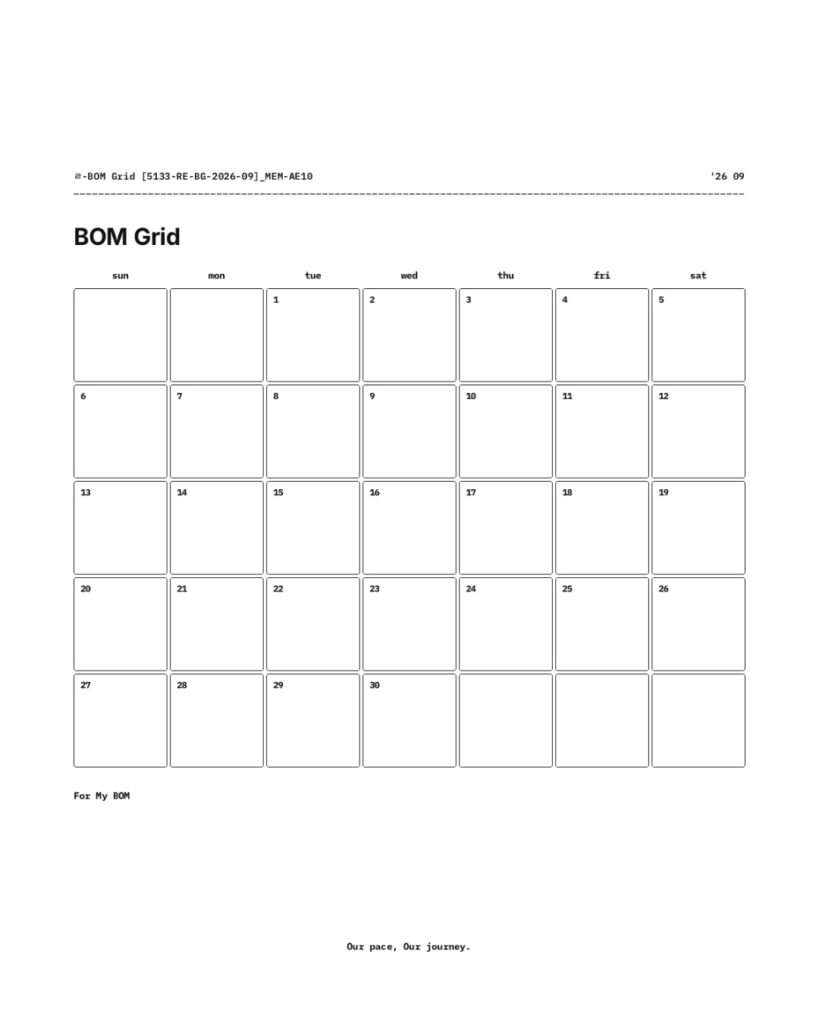
    Blank September 2026 BOM Grid with dated photo boxes and a For My BOM note area.

    September 2026: A Month Told Through Photos

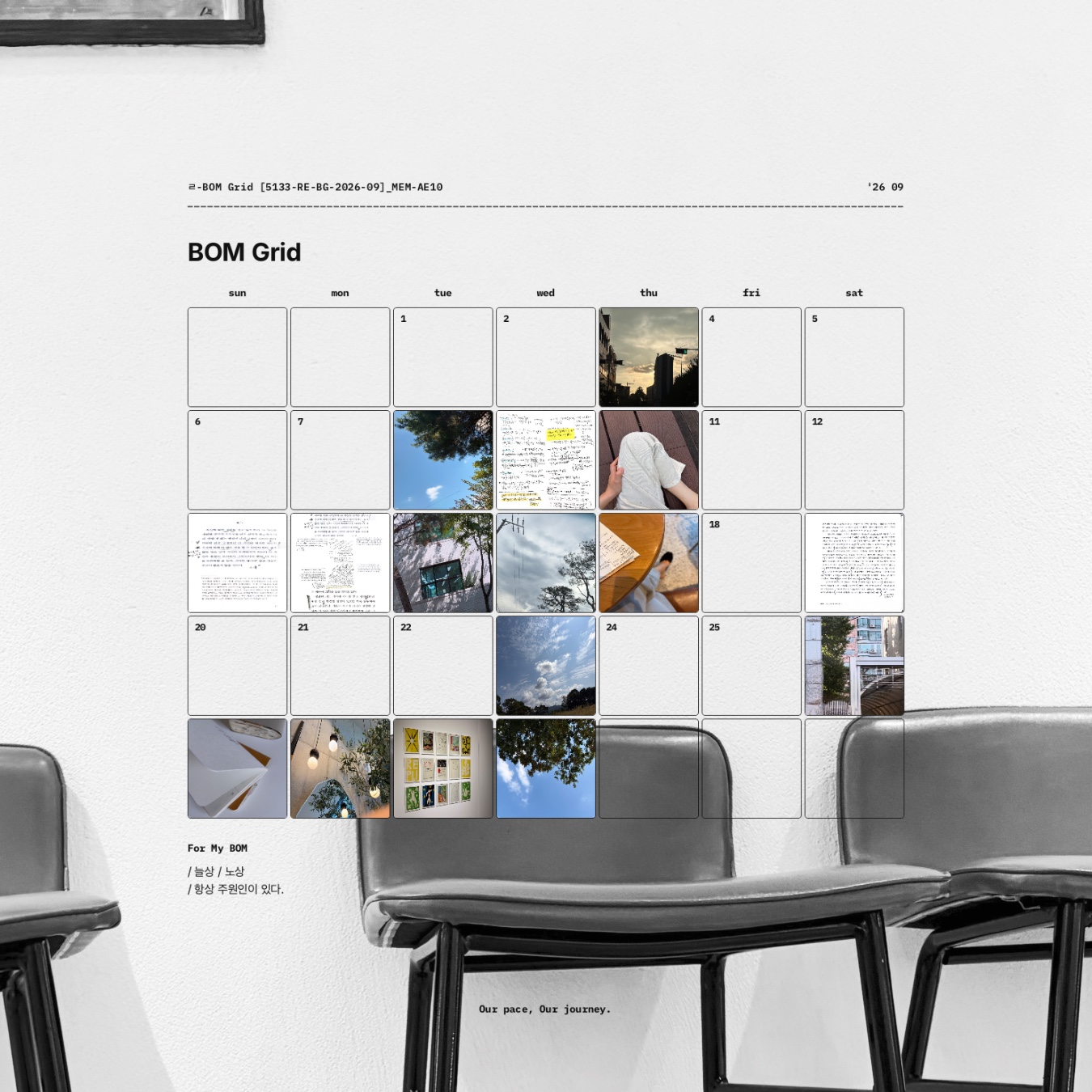
    My September BOM Grid brings together photographs of skies, trees, streets, interiors, and pages of notes.

    Some dates contain photographs, while others remain blank. Viewed together, the images form a visual record of September without needing a written entry for each day.

    Beneath the calendar is For My BOM, a space for a few words or a short thought about the month. In this example, the note sits below the completed photo grid.

    The photographs show individual moments. The monthly layout lets you see them together.
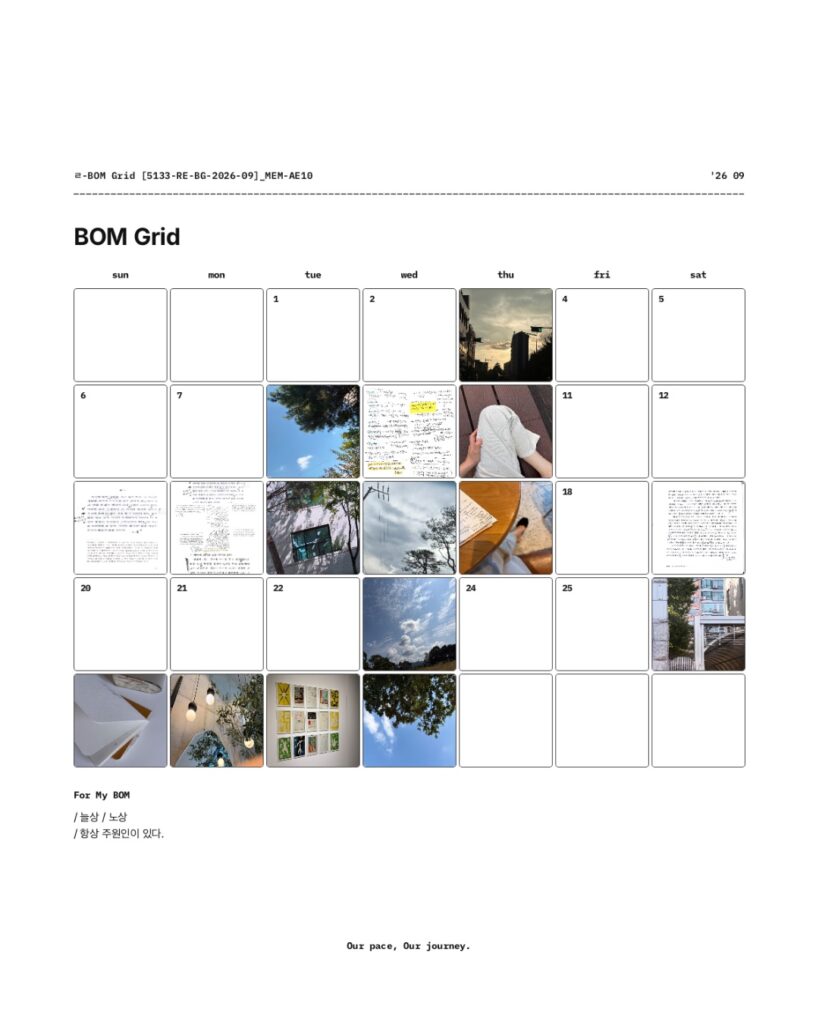
    September 2026 BOM Grid filled with photos of sky, trees, notes, streets, and interiors, with some date boxes left blank.

    Export Your Photo Journal for Goodnotes or Your Own Layout

    BOM Grid lets you download your monthly page as PNG, JPG, or PDF.

    You can save the completed photo journal as a PDF and keep it in Goodnotes alongside your other records, or use a JPG as a single image of the month.

    PNG also supports a transparent-background option. This lets you place the photo grid over another photograph or background, as shown in the featured image, where the September grid appears over a black-and-white interior photograph.

    If you prefer to arrange your photos outside Flowhere, you can download a blank monthly layout as well.

    The same calendar can therefore work as a digital photo diary, a saved PDF, or part of a larger visual composition.

    Keep Your Monthly Photos in a Personal Archive

    A monthly photo journal can also become something you return to later.

    When you save your records in Flowhere, you can revisit earlier months through the Archive. As records accumulate across different years, photographs from the same month can become part of a five-year view of your personal history.

    A photograph that seemed ordinary when you took it may stand out differently when you see it alongside records from another year.

    Start Your October 2026 Photo Journal

    Open BOM Grid in Flowhere and choose October 2026.

    Add photographs to the dates you want to keep, leave a note in For My BOM if you like, and save or export your monthly page.

    You can begin with the photographs you already have and continue adding to the grid throughout the month.

    Prefer to keep a month through writing and notes rather than photographs? Reflection Monthly offers a different way to record the month on one page.

    → Explore Reflection Monthly in Flowhere

    One month of photographs, collected on one page.

    𝑶𝒖𝒓 𝒑𝒂𝒄𝒆, 𝑶𝒖𝒓 𝒋𝒐𝒖𝒓𝒏𝒆𝒚.
  • One Dot a Day: A Simple Daily Mood Tracker in Flowhere — 하루·Dot [no.5133]

    One Dot a Day: A Simple Daily Mood Tracker in Flowhere — 하루·Dot [no.5133]

    Not every day needs a full journal entry.

    Sometimes one dot is enough.

    Flowhere’s 하루·Dot is a simple daily tracker that lets you place one dot on a 1–5 scale and see how those dots form a line over time.

    You decide what the dot represents—mood, energy, focus, work, physical condition, or something else you want to keep noticing.

    You can record in 0.5 steps, view your records across 1 month, 3 months, 6 months, or 1 year, and export the page as PNG, JPG, or PDF.

    The images in this post show my actual 2026 records as they appear across the 1M, 3M, 6M, and 1Y views.

    하루·Dot at a Glance

    ItemDetails
    Daily recordOne dot
    Scale1–5
    Precision0.5 steps available
    InputTap or drag
    LensChoose what you want to track
    Views1M · 3M · 6M · 1Y
    Short noteFor·Dot
    Save pageYes
    ExportPNG · JPG · PDF
    Goodnotes useExport and continue with notes or handwriting
    ArchiveRecords can continue in Flowhere

    One Dot a Day

    하루·Dot starts with a very small action: decide where today sits on your own 1–5 scale and leave one dot.

    You can use whole numbers or record in 0.5 steps when you want a little more precision.

    One dot does not need to explain the whole day.

    Its meaning comes from the Lens you choose and from the other dots that gather around it over time.

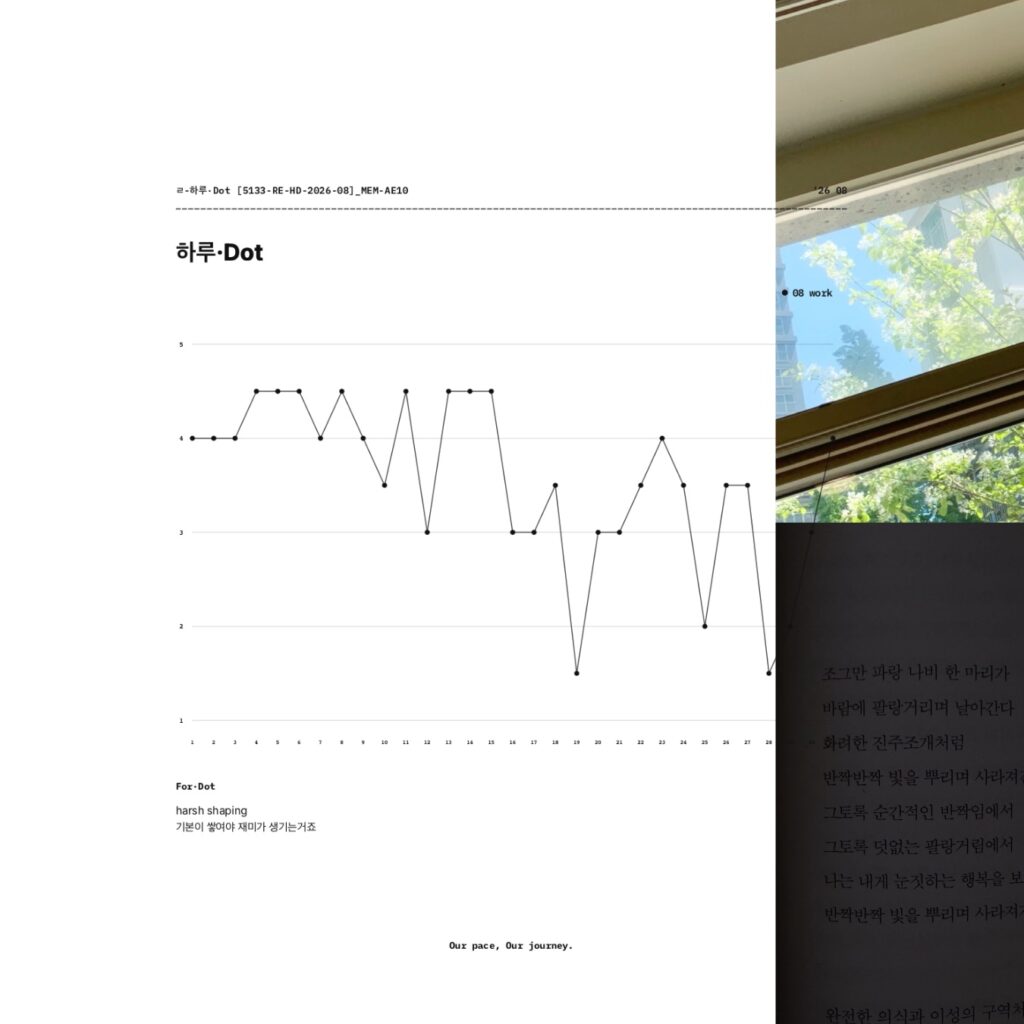
    In the August 2026 view shown below, the Lens is work.

    The individual scores move up and down across the recorded days. Seen together, they begin to form a visual flow rather than a series of isolated ratings.

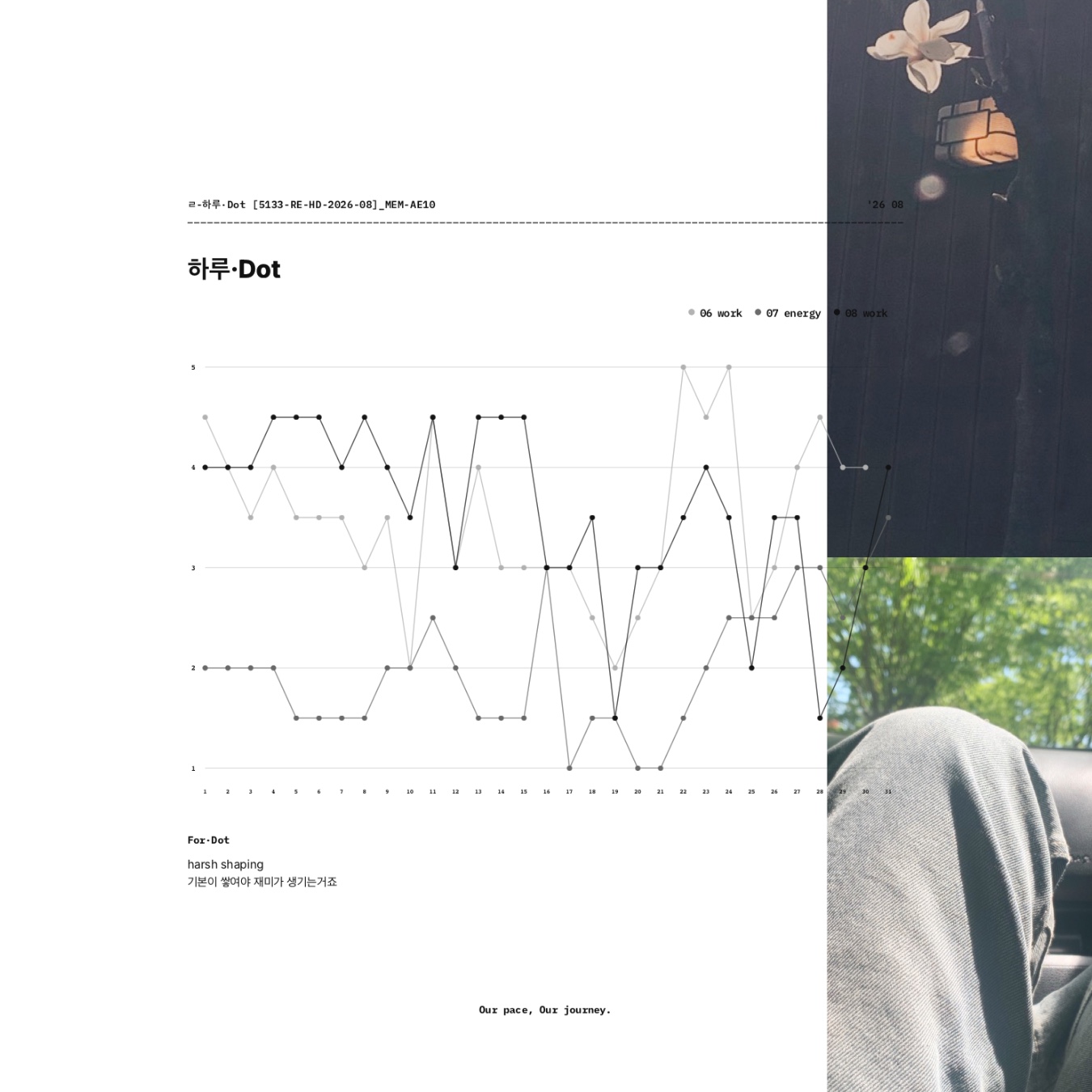
    August 2026 하루·Dot 1-month view showing recorded work ratings as connected dots on a 1–5 scale beside everyday images.

    As more dots accumulate, a single score becomes easier to see as part of a larger record.

    From One Month to a Longer View

    하루·Dot lets you change the time range without changing the way you record.

    The same dot-based records can be viewed across 1M, 3M, 6M, or 1Y.


    3M — See Recent Records Together

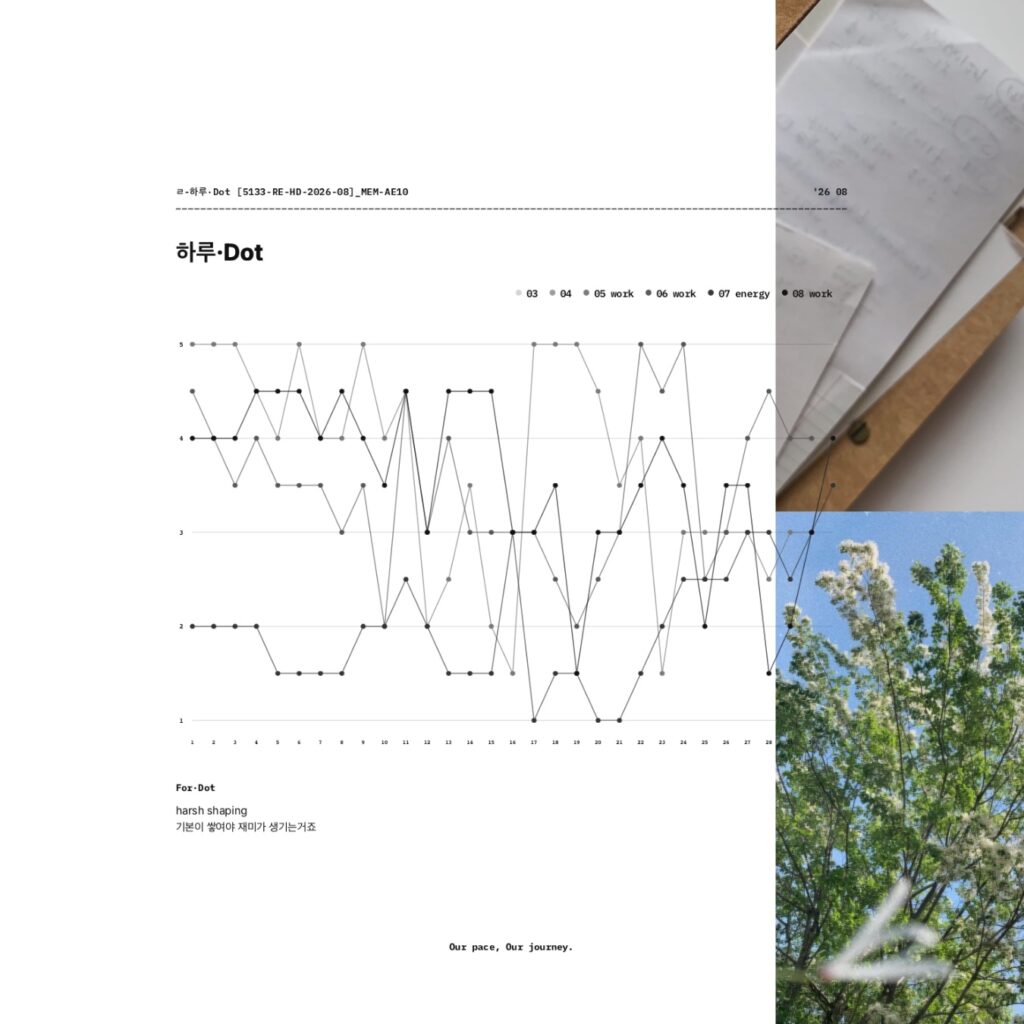
    The 3-month view brings recent records into the same graph.

    In the Featured Image, June work, July energy, and August work appear together.

    Instead of summarizing each period in a long written entry, you can see several recent records within one view and notice how their lines sit alongside one another.


    6M — Widen the Frame

    The 6-month view places the available records within a wider time frame.

    This makes it easier to step back from individual days and see how separate entries relate across months.

    하루·Dot 6-month view showing available rating lines on a 1–5 scale beside photos of notes and green trees.

    1Y — See the Record in a Full-Year Frame

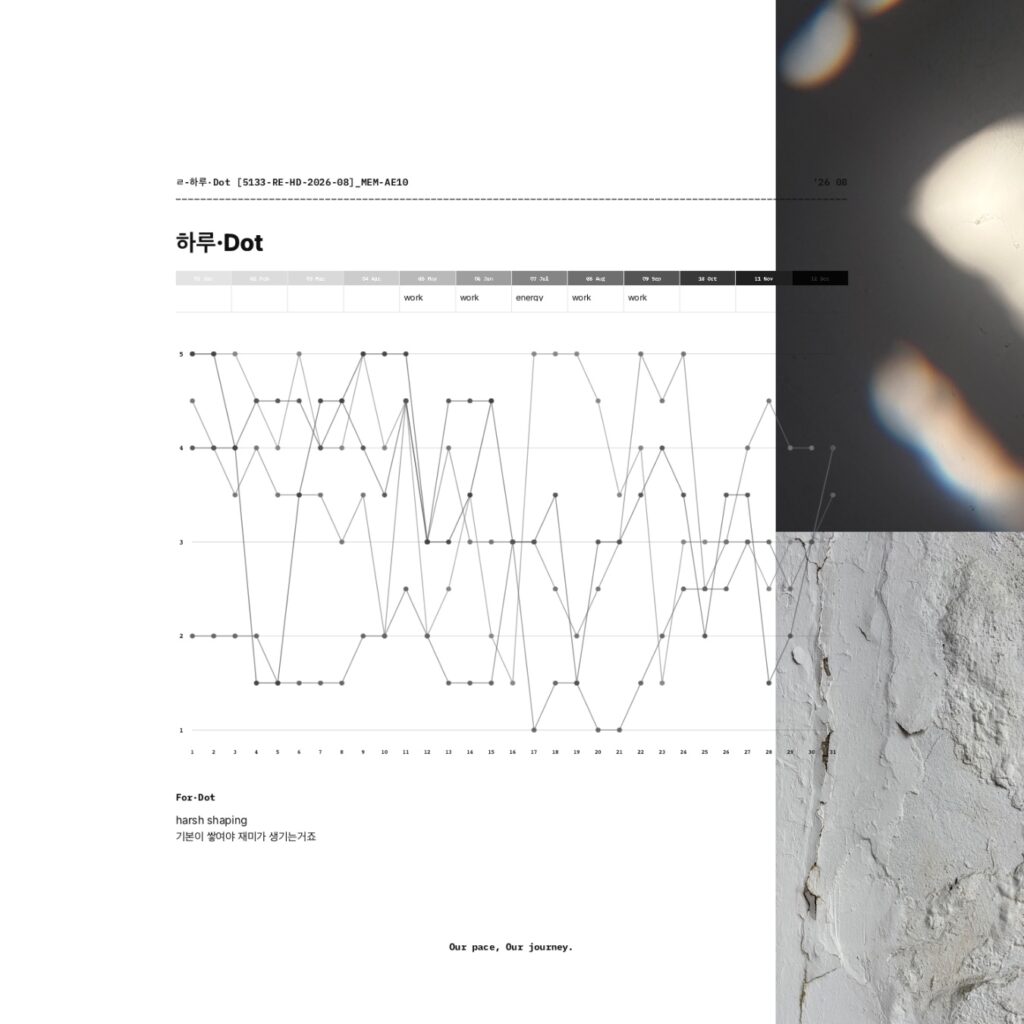
    The 1-year view gives you the widest frame available in 하루·Dot.

    By placing the record within a January-to-December layout, it becomes easier to look beyond individual days and see the overall shape of what has been recorded.

    하루·Dot 1-year view showing available rating lines within a January-to-December layout beside abstract light and textured wall photos.

    하루·Dot does not decide what those lines mean for you.

    It gives you a way to look at what you have recorded and notice what stands out from where you are now.

    Choose What the Dot Means

    There is no single required meaning for a 하루·Dot score.
    The Lens is the part you choose.

    For example, you might track:

    • Mood
    • Energy
    • Focus
    • Physical condition
    • Work

    Something specific to your own routine
    The point is not to find the “right” thing to measure.

    Choose something you want to keep noticing.

    A mood Lens can work as a lightweight mood journal.

    An energy Lens can show how your perceived energy changes from day to day.

    A work Lens can leave a simple record of how work felt during a particular period.

    The scale remains simple. The meaning comes from the Lens you give it.

    For·Dot — Add a Little Context

    Below the graph is For·Dot, a space for a short line of text.

    You can leave a word, sentence, or small note when a dot alone is not enough for what you want to remember.

    The graph keeps the flow visible.

    For·Dot adds a little context beside it.

    Can I Use 하루·Dot With Goodnotes?

    Yes.

    하루·Dot is recorded in Flowhere, but you can export the page whenever you want as:

    • PNG
    • JPG
    • PDF

    You might record part of a month in Flowhere, export that view to Goodnotes, and continue by adding handwriting, notes, or other material there.

    Or you can keep adding dots in Flowhere and export particular 1M, 3M, 6M, or 1Y views whenever you want to keep one elsewhere.

    Flowhere and Goodnotes do not have to be separate workflows.

    You can let the dot record continue to develop in Flowhere and bring any view into Goodnotes whenever that fits the way you want to journal.

    Prefer to Record the Month With Photos?

    If numbers and lines are not how you want to remember a month, BOM Grid offers another visual approach in Flowhere.

    Instead of giving the day a score, you leave photographs by date and let the month build into one photo grid.

    → Explore BOM Grid — A Monthly Photo Journal in Flowhere

    Start With Today’s Dot

    You do not need to explain the whole day.

    Choose what you want to keep noticing.

    Decide where today sits on your scale.

    Leave one dot.

    Tomorrow can be another.

    As the record grows, you can step back and see the flow taking shape.

    One dot a day. A flow over time.

    𝑶𝒖𝒓 𝒑𝒂𝒄𝒆, 𝑶𝒖𝒓 𝒋𝒐𝒖𝒓𝒏𝒆𝒚.